Agency Collaboration Introduces New Safety Curriculum to School in Arkansas

By Emma Goad
The Arkansas Department of Transportation (ARDOT) is preparing to roll out a new statewide safety initiative, STREET SMART, aimed at educating K-12 students about road safety. Set to launch during the 2025–2026 school year, the program will be geared toward grades six through eight, equipping students with essential skills and knowledge before they become drivers. The goal is for the program to expand to include additional grades in subsequent years.
 The program will focus on pedestrian, bicycle, passenger, and motor vehicle safety, delivering age-appropriate materials in a format that engages students through multiple learning styles. It is being developed collaboratively by ARDOT and the Arkansas Department of Education (ADE).
This is coming on the heels of the Slow Down, Phone Down campaign, now in its fourth year. Slow Down, Phone Down is a work zone safety campaign that encourages drivers to slow down and minimize distractions while driving in work zones to protect both themselves and road workers. Recently, advertising for this campaign has been focused toward 18 to 24-year-olds. To reach people in this age range, ARDOT is pushing this campaign on social media platforms like Snapchat and Instagram, gaming websites such as Twitch, and streaming services like Crunchyroll, among others.
While the Slow Down, Phone Down campaign is currently targeting young drivers specifically in work zones, the Street Smart campaign shapes the next generation of drivers, those who are still passengers and observers, to prepare them before it’s their turn behind the wheel.
 “The K-12 educational program is trying to instill safety conscious behavior in young people,” Jessie X. Jones, ARDOT’s Chief Engineer for Preconstruction, said. “We want Arkansas students to possess the skills needed to be more than just safe drivers. We want them to also be safe passengers, cyclists, and pedestrians when they are traveling.”
The inter-agency collaboration between ARDOT and ADE brings together transportation expertise and relevant educational standards to ensure success in the classroom. ARDOT utilized data and statistics to determine which transportation-related topics should be addressed, and ADE provided recommendations on how best to deliver the message to students.
“We’re looking at several delivery modes to engage students in different ways,” Travis Brooks, Division Head of ARDOT’s Planning & Research Division, said. “Some of the materials are lecture-style, but we’ll also have hands-on exercises, traditional testing objectives, and shortform videos designed for a student body that is used to platforms like Instagram.”
The Street Smart curriculum will progress by grade level. In sixth grade, students will learn the basics of pedestrian, bicycle, and bus safety. In seventh grade, more advanced safety principles are introduced, including how to be a safe passenger and how to avoid distracting the driver. In eighth grade, students will begin preparing for the responsibilities of being behind the wheel.
“We started with sixth to eighth graders because that’s the age group that would be the best to target at the beginning,” Jones said. “They haven’t started driving yet.”
“If we can get this in their hands year after year before they start driving, I really feel like it could save lives” – Adam Stage, Principal | Fountain Lake Middle School & Street Smart panelist
EDUCATOR PANEL SHAPED EARLY DEVELOPMENT
To ensure the curriculum would be practical and effective in real-world classroom settings, ARDOT hosted a panel of educators in the early stages of development. Adam Stage, the principal of Fountain Lake Middle School and panelist, helped provide insights into how the curriculum could be implemented and what would resonate with students.
“We really dealt more with the implementation,” Stage said. “How do we actually get it into a classroom effectively? What class do we put it in?”
The panel helped shape the curriculum by categorizing it into pedestrian, bicycle, and driver safety modules, with the goal of keeping the educational material relevant to the grade-level. The panel also determined the lessons would be best suited under the health curriculum, although the content is designed to be cross-curricular.
Stage described the collaboration as “very productive,” noting that former educators involved in the project had already contributed valuable foundational work.
“ARDOT worked very well with us. They brought in the transportation expertise, and we brought in the classroom perspective,” Stage said.
Stage was inspired to participate due to a personal experience that underscored the curriculum’s importance.
“I remember there was a kid when I was a teacher at Magnet Cove who died in a car accident. The whole community was heartbroken. That stuck with me,” Stage said. “If we can get this in their hands year after year before they start driving, I really feel like it could save lives.”
He emphasized that while students currently study for a driver’s test by memorizing answers from a handbook, Street Smart offers a deeper, more meaningful engagement with safety.
“I don’t think we’ve ever had a curriculum that really focused on what you do as a bicyclist or pedestrian,” Stage said.

Short videos featuring teen actors from Arkansas will be used to present safety messages in a relatable way.
HANDS-ON LEARNING AND REAL-WORLD APPLICATIONS
The curriculum will include interactive web-based games, as well as short videos featuring teen actors from Arkansas to present safety messages in a relatable way.
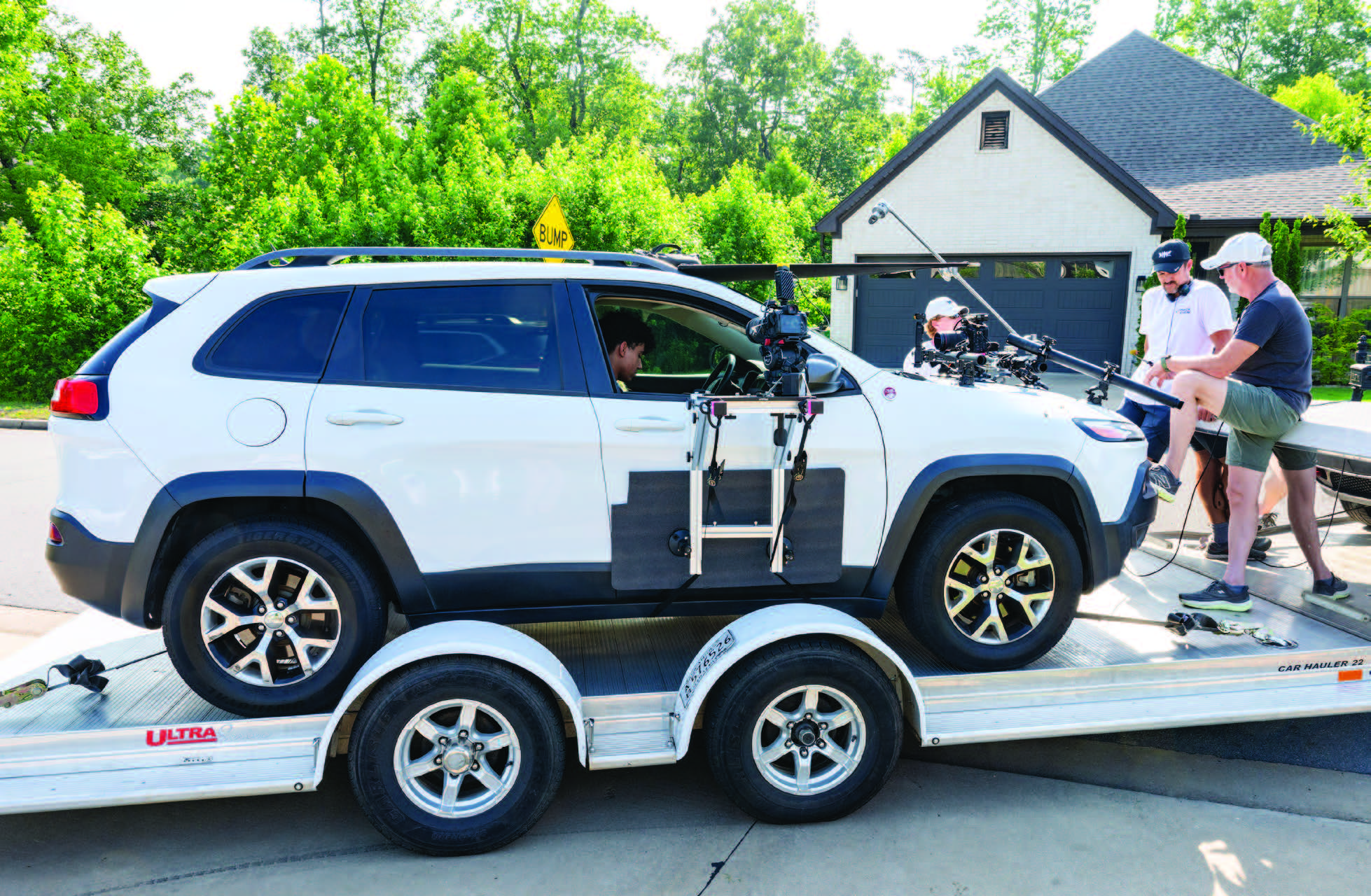
To create the videos, actors spent a week filming at various locations across Little Rock with the video production company Waymack & Crew. Six Arkansas teens learned and recorded ten scripts, which were then edited and produced for the curriculum. Some videos were shot at a crosswalk downtown, others on a neighborhood sidewalk, and some inside a car mounted on a trailer. These teens are the face of Street Smart.
The educational materials will be designed for use in several subject areas. One example Brooks cited is a hands-on physics experiment designed to show how speed impacts crash outcomes, which connects road safety to science education.
The program draws inspiration from a successful curriculum implemented by the Georgia Department of Transportation. After seeing Georgia’s results presented at a national conference, ARDOT initiated its own campaign, adapting the concept to fit Arkansas’ educational standards. Under the direction of previous ARDOT Director Lorie Tudor, Jones was put to the task of learning from Georgia’s experience.
“She thought it was a great idea that could potentially benefit Arkansas,” Jones said. “So, she asked us to look into it, and the Commission authorized us to proceed.”
Georgia’s perspective was eye-opening for ARDOT, but Jones wanted to be sure that the program was tailored to Arkansas specifically to be successful.
“We want to make sure this material is developed and meets the standards that Arkansas has, whether that’s in social studies, health, or science,” Jones said.
“The Department of Education is reviewing everything just like ARDOT is,” Brooks said. “Educators from across the state provided early feedback on educational objectives, opportunities for integration into the curriculum, and the tools for engaging with students.”
FUNDING AND FUTURE EXPANSION
Funded through the Highway Safety Improvement Program (HSIP), ARDOT has committed $500,000 to the development of the sixth through eighth grade phase. Pending success with phase one, future phases, including full K-12 implementation, will be supported through additional HSIP funds.
“Arkansas receives approximately $40 million per year in HSIP funds,” Brooks said. “Most of that goes to infrastructure projects, but educational programming is also eligible, and that’s what we’re doing here.”
Early measures of success will focus on distribution and implementation, such as how many classrooms and students the curriculum reaches. Long-term, the goal is to impact behavior and reduce injuries and fatalities.
“That is daunting,” Jones said of the current crash statistics. “If we instill safety in the minds of students before they get behind the wheel, we expect to see a reduction in crashes.”
Brooks echoed this goal. “There are certainly some very concerning trends in the safety data—distracted driving, seat belt use, impaired driving. We’re going to be educating students about all of those.”
ARDOT and ADE have formed a working group that meets regularly to review the program’s development.
“It’s really a team effort,” Brooks said. “Everyone’s bringing something essential to the table, whether it’s safety, academic standards, or creative content. That collaboration is what will make this successful.”
Street Smart is a program that encourages students to not just be safe drivers someday, but also to understand the importance of being a safe pedestrian, bicyclist, or passenger. Instilling this knowledge at the educational level will ensure students see that they’re just as impacted by road safety as anyone else.
“We hope this will resonate with students, and that they will go home, talk to their parents, siblings, and neighbors about this,” Jones said. “It could be something propagated through them, and we hope to really see a difference in people’s behavior.”